Introduction
Numbers have long been used in different traditions to explore personality, tendencies, and patterns in life. In numerology, each number is believed to carry a symbolic meaning that can offer a different perspective on an individual’s nature and experiences.
Two approaches commonly explored in modern Indian numerology are Vedic Numerology and the Lo Shu Grid. Although both work with numbers from 1 to 9 and may use a person’s date of birth, their methods of interpretation are different.
Vedic Numerology places considerable emphasis on planetary associations, Birth Numbers, Destiny Numbers, and Name Numbers. The Lo Shu Grid, on the other hand, uses a structured numerical arrangement to examine the presence, absence, and repetition of numbers.
Understanding both approaches can help us explore numerology from different perspectives rather than relying on a single numerical interpretation.
What Is Vedic Numerology?
Vedic Numerology, commonly referred to as Ank Jyotish in contemporary Indian practice, is a numerological approach that associates numbers with planetary influences.
Each number from 1 to 9 is traditionally connected with a planetary symbol:
- 1 – Sun: Leadership, confidence, and individuality.
- 2 – Moon: Sensitivity, cooperation, and emotions.
- 3 – Jupiter: Knowledge, wisdom, and expansion.
- 4 – Rahu: Unconventional thinking and ambition.
- 5 – Mercury: Communication, adaptability, and intelligence.
- 6 – Venus: Harmony, relationships, and creativity.
- 7 – Ketu: Introspection, spirituality, and analysis.
- 8 – Saturn: Discipline, responsibility, and perseverance.
- 9 – Mars: Courage, energy, and determination.
Two important concepts in this approach are the Birth Number (Moolank), calculated from the day of birth, and the Destiny Number (Bhagyank), calculated from the complete date of birth.
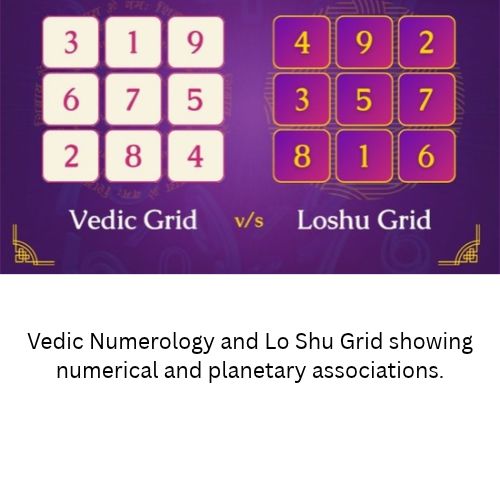
The traditional arrangement of the numbers is:
| 3 | 1 | 9 |
| 6 | 7 | 5 |
| 2 | 8 | 4 |
Name Numerology is another aspect explored by practitioners, where the numerical value of a name is interpreted according to a particular letter-number system.
These concepts provide a foundation for understanding how numbers are interpreted through planetary symbolism.
What Is the Lo Shu Grid?
The Lo Shu Grid is a traditional Chinese numerical square consisting of nine positions arranged in a three-by-three pattern. Its arrangement is based on the numbers 1 to 9, with every row, column, and diagonal adding up to 15.
In contemporary numerology practice, the grid is commonly prepared using the digits of a person’s date of birth.
The traditional arrangement is:
| 4 | 9 | 2 |
| 3 | 5 | 7 |
| 8 | 1 | 6 |
Each number occupies a fixed position. When preparing a personal Lo Shu Grid, the digits of the birth date are placed in their corresponding positions. Zero is generally excluded because the grid contains only numbers from 1 to 9.
The resulting pattern is examined through:
- Present numbers: Numbers appearing in the date of birth.
- Missing numbers: Numbers that do not appear in the grid.
- Repeated numbers: Numbers occurring more than once.
- Planes and arrows: Particular combinations of numbers that are traditionally interpreted as representing different qualities or tendencies.
The grid therefore provides a visual representation of numerical patterns rather than focusing only on one or two reduced numbers.
How Are the Two Systems Different?
Although both approaches use numbers, they do not follow exactly the same calculation or interpretation methods.
Vedic Numerology focuses on the symbolic significance of individual numbers and their planetary associations. It examines concepts such as Birth Number, Destiny Number, and Name Number.
The Lo Shu Grid focuses on the arrangement and distribution of numbers within a fixed numerical structure. It examines which numbers are present, missing, or repeated and how they form particular patterns.
For example, a person’s Birth Number may be 5, traditionally associated with Mercury. In the Lo Shu Grid, the number 5 also occupies the central position.
The first interpretation considers the planetary symbolism of the number, while the second examines its position and occurrence within the grid.
This is one way the two approaches can offer different perspectives on the same number.
It is important to remember that the Lo Shu Grid originated in Chinese tradition. Its use alongside planetary number associations is part of modern numerology practice and should not be confused with the classical origins of Vedic astrology.
How Do They Complement Each Other?
The real value of exploring these approaches together lies in understanding what each one examines.
Vedic Numerology provides a way to interpret the symbolic significance of numbers through planetary associations. It helps practitioners explore Birth Numbers, Destiny Numbers, and Name Numbers within their chosen numerological framework.
The Lo Shu Grid adds another dimension by presenting the numbers in a visual pattern. Instead of examining only an individual’s primary numbers, it considers the distribution of all the birth-date digits.
For instance, a person may have a Birth Number associated with leadership and initiative. However, their Lo Shu Grid may contain repeated numbers or missing numbers that are traditionally interpreted as areas requiring greater awareness or conscious development.
Looking at both approaches can therefore encourage a broader discussion about personal tendencies, strengths, and areas for improvement.
Neither system needs to replace the other. They can be explored independently and then considered together, provided their different methods are understood.
Can Name Numerology Also Be Connected with the Lo Shu Grid?
Yes, practitioners sometimes consider Name Numerology alongside a Lo Shu Grid reading.
Name Numerology examines the numerical value assigned to the letters of a person’s name using a particular calculation system. The resulting number is then interpreted according to the conventions of that system.
The Lo Shu Grid, meanwhile, is generally prepared from the date of birth and examines its numerical distribution.
Some practitioners use these approaches together to explore both birth-date patterns and name-related numerical associations.
However, a name number should not automatically be added to the Lo Shu Grid. Different practitioners follow different grid calculation methods, so it is important to understand the approach being used.
You can explore our earlier articles on Name Numerology and Name Correction to understand how names are studied through numerical interpretations.
Why Is It Important to Understand Both Approaches?
Understanding the differences between Vedic Numerology and the Lo Shu Grid helps avoid confusion when exploring different numerological readings.
A person may receive different interpretations from the two approaches because they examine different aspects of numerical patterns.
Rather than treating these differences as contradictions, it is useful to understand the method behind each interpretation.
Both approaches belong to traditional belief systems and are not scientifically established methods of assessing personality or predicting future events. They are best approached as tools for reflection and self-exploration rather than as fixed descriptions of an individual’s abilities or destiny.
Conclusion
Vedic Numerology and the Lo Shu Grid offer two different ways of exploring the symbolic significance of numbers. While Vedic Numerology emphasises planetary associations and individual numbers, the Lo Shu Grid examines the arrangement, presence, absence, and repetition of numbers.
When understood separately and considered thoughtfully, these approaches can complement each other by offering different perspectives on personal tendencies and numerical patterns.
At Mystical Barkha, our aim is to make traditional numerological concepts easier to understand, helping you explore their meanings with curiosity, awareness, and a balanced perspective.
Pingback: Understanding the Dasha System - Mystical Barkha