Introduction
In numerology, numbers are traditionally believed to carry symbolic meanings that can offer insights into personality, natural tendencies, and life’s experiences. Among the numbers commonly explored in Indian numerology are the Birth Number and the Destiny Number.
Although these terms may sound similar, they are calculated differently and are traditionally interpreted for different purposes. Understanding both can help you explore the basics of Vedic numerology and see how it relates to other approaches, such as Name Numerology and the Lo Shu Grid.
In this article, we will explain how to calculate your Birth Number and Destiny Number, understand their traditional significance, and distinguish them from other numerological concepts.
What Is a Birth Number?
The Birth Number, often called the Psychic Number in Indian numerology, is calculated using the day of the month on which you were born.
To calculate it, add the digits of your birth day until you obtain a single digit from 1 to 9.
Example 1: If you were born on the 14th of any month:
1 + 4 = 5
Your Birth Number is 5.
Example 2: If you were born on the 28th:
2 + 8 = 10
1 + 0 = 1
Your Birth Number is 1.
For someone born on the 7th, the Birth Number is simply 7.
In traditional numerology, the Birth Number is associated with a person’s natural inclinations, personal preferences, and characteristic ways of responding to situations. These interpretations are symbolic rather than scientifically established descriptions of personality.
What Is a Destiny Number?
The Destiny Number, commonly called the Life Path Number in some numerology traditions, is generally calculated in Indian numerology by adding all the digits of the complete date of birth and reducing the total to a single digit.
Let’s understand this with an example.
Suppose a person was born on 14 August 1996.
The date of birth is 14/08/1996.
Add all the digits:
1 + 4 + 0 + 8 + 1 + 9 + 9 + 6 = 38
Then reduce the total:
3 + 8 = 11
1 + 1 = 2
The Destiny Number is 2.
In this approach, the Destiny Number is traditionally interpreted in relation to a person’s broader life journey, experiences, opportunities, and lessons.
Numerology traditions vary in their calculation and interpretation methods. Some preserve compound numbers or use different conventions, so it is useful to state the method being followed when calculating a number.
Birth Number and Destiny Number: What Is the Difference?
Both numbers are derived from the date of birth, but they use different parts of that date.
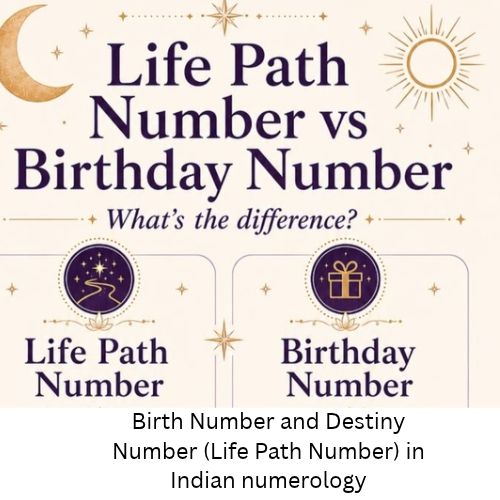
Birth Number: Calculated from the day of birth alone. It is traditionally associated with natural tendencies and personal characteristics.
Destiny Number: Calculated from the complete date of birth. It is traditionally associated with broader life themes and the journey a person experiences.
For example, someone born on 14 August 1996 has a Birth Number of 5 and a Destiny Number of 2.
The two numbers may therefore be interpreted differently within numerology, even though they belong to the same individual.
Neither number should be treated as a fixed verdict about a person’s abilities, future, or potential. They are best approached as concepts within a traditional belief system.
What Do the Numbers 1 to 9 Traditionally Represent?
In Indian numerology, each single-digit number is commonly associated with particular qualities. Interpretations differ among practitioners, but the following are some widely used symbolic associations.
- 1: Independence, leadership, and initiative.
- 2: Cooperation, sensitivity, and diplomacy.
- 3: Expression, creativity, and communication.
- 4: Structure, discipline, and practicality.
- 5: Adaptability, curiosity, and flexibility.
- 6: Responsibility, harmony, and care.
- 7: Reflection, analysis, and the search for knowledge.
- 8: Organisation, ambition, and responsibility.
- 9: Compassion, courage, and humanitarian concerns.
These descriptions are traditional numerological associations, not scientifically validated personality assessments. A person’s character and decisions are shaped by many factors, including upbringing, environment, learning, and personal experience.
How Are These Numbers Connected with Vedic Numerology?
In Vedic numerology, numbers are often associated with planetary symbolism. For example, the number 1 is commonly associated with the Sun, 2 with the Moon, 3 with Jupiter, 4 with Rahu, 5 with Mercury, 6 with Venus, 7 with Ketu, 8 with Saturn, and 9 with Mars.
These associations are used by practitioners to interpret numbers within their chosen numerological framework.
However, Birth Number and Destiny Number calculations are not the same as a Vedic astrology birth chart. The Dasha system, discussed in our article on the Dasha System in Vedic Astrology, uses planetary periods calculated through astrological methods. A person’s Birth Number or Destiny Number does not independently establish their Dasha periods.
Understanding this distinction helps prevent different systems from being confused with one another.
How Do Birth and Destiny Numbers Differ from the Lo Shu Grid?
The Lo Shu Grid is a separate numerological approach that arranges numbers in a traditional three-by-three grid. In contemporary practice, it is often used to study the presence or absence of digits derived from a person’s date of birth.
Birth Number and Destiny Number calculations reduce selected digits to a single number, whereas a Lo Shu Grid reading examines numerical patterns within the grid according to the method being followed.
Both approaches use the date of birth, but their interpretations and methods are different. They can be explored separately before considering how practitioners may combine their perspectives.
You can also explore our articles on Name Numerology and Name Correction to understand how names are examined within another branch of numerology.
Conclusion
The Birth Number and Destiny Number are two foundational concepts in Indian numerology. The Birth Number is calculated from the day of birth, while the Destiny Number is derived from the complete date of birth.
Within traditional numerology, these numbers are associated with different aspects of personality and life’s journey. However, they should not be regarded as scientifically proven predictors of behaviour or future events.
Learning how these numbers are calculated—and how they differ from the Dasha system and the Lo Shu Grid—provides a clearer understanding of the various approaches used in numerology.
At Mystical Barkha, our aim is to make these traditional concepts easier to understand and encourage thoughtful self-reflection while recognising the importance of personal choices and real-world experiences.